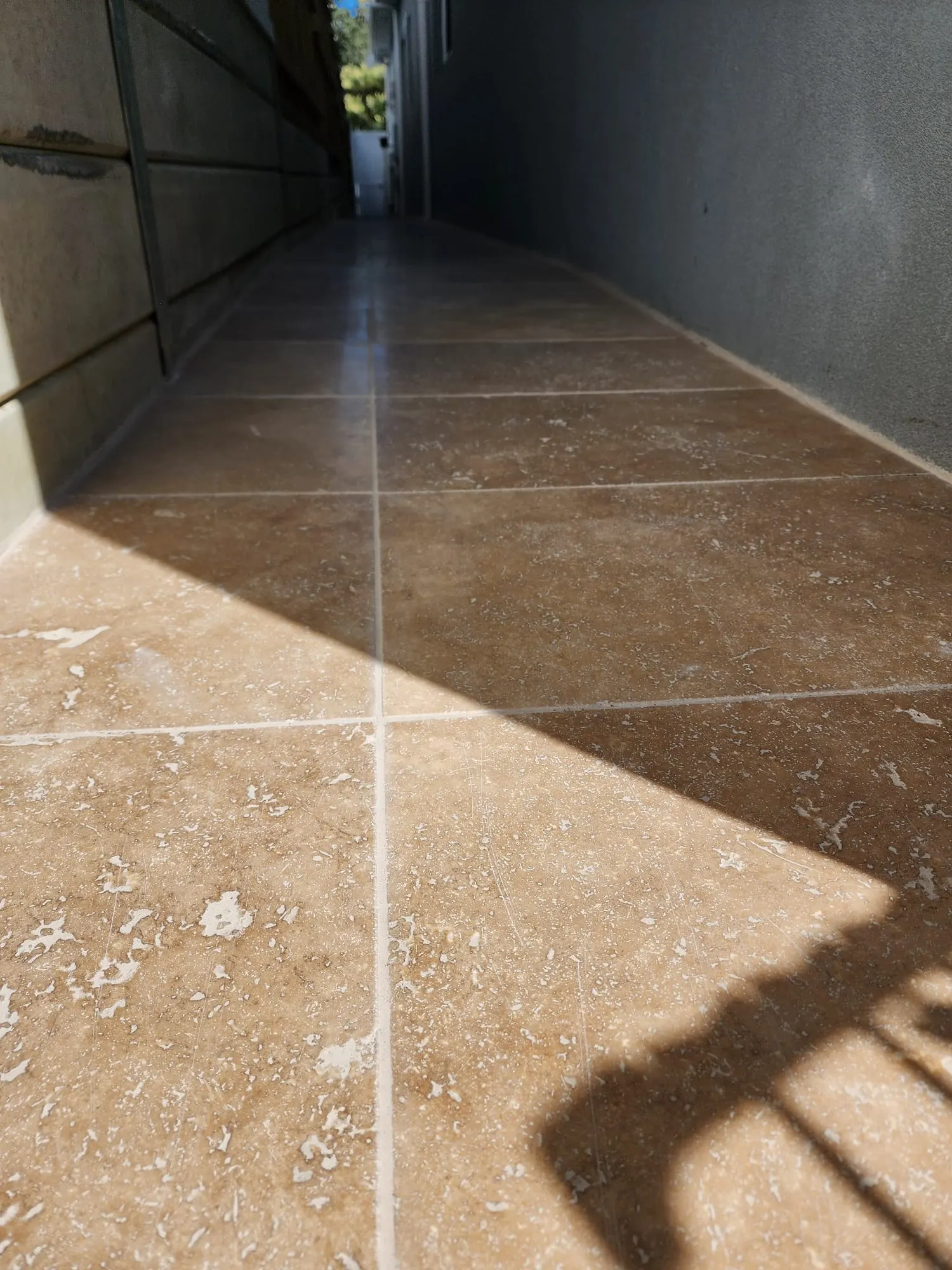
Every floor tile sold in Australia should come with a slip resistance rating. It is the single most important number on a floor tile spec sheet, and the one most often overlooked when choosing on looks alone.
How tiles are tested
The main test is the wet pendulum test in AS 4586. A rubber slider swings across a wet tile and the result is classed from P0 (very low slip resistance) to P5 (very high). You may also see older R ratings from the oil-wet ramp test, R9 to R13, especially on European tiles.
Which rating where
The guidance most designers use is the Standards Australia handbook HB 198. As a starting point for homes:
- Living areas and bedrooms (dry): P2 or above is usually fine.
- Kitchens, laundries and bathrooms: P3 is the common target for wet internal floors.
- Outdoor areas, alfresco and pool surrounds: P4 to P5, especially on slopes, steps and ramps.
Commercial floors, ramps and public areas have their own requirements, and your certifier or the project specification has the final say. We provide the test certificate for the exact tile, so there is no guesswork.
The trade-off
Higher slip resistance usually means more texture, and more texture can mean more effort to clean. For bathrooms, a matte P3 tile is often the sweet spot. Outdoors, choose the external version of your indoor tile so the look continues while the grip increases.
Our approach
We check the rating of every floor tile against where it is going before it goes on your quote, and we flag it if a tile you love is not right for the space.
Frequently asked questions
Does a polished tile have a slip rating?
Yes, usually a low one (P0 to P1 wet). Polished tiles suit dry internal areas and walls, not bathrooms or outdoors.
Is P5 always better?
Not for every room. Very high slip ratings are rougher underfoot and harder to clean, so they are best kept for outdoor slopes, ramps and pool surrounds.
Want a second opinion? Book a consultation and we will talk it through for your space.
Book a consultation